
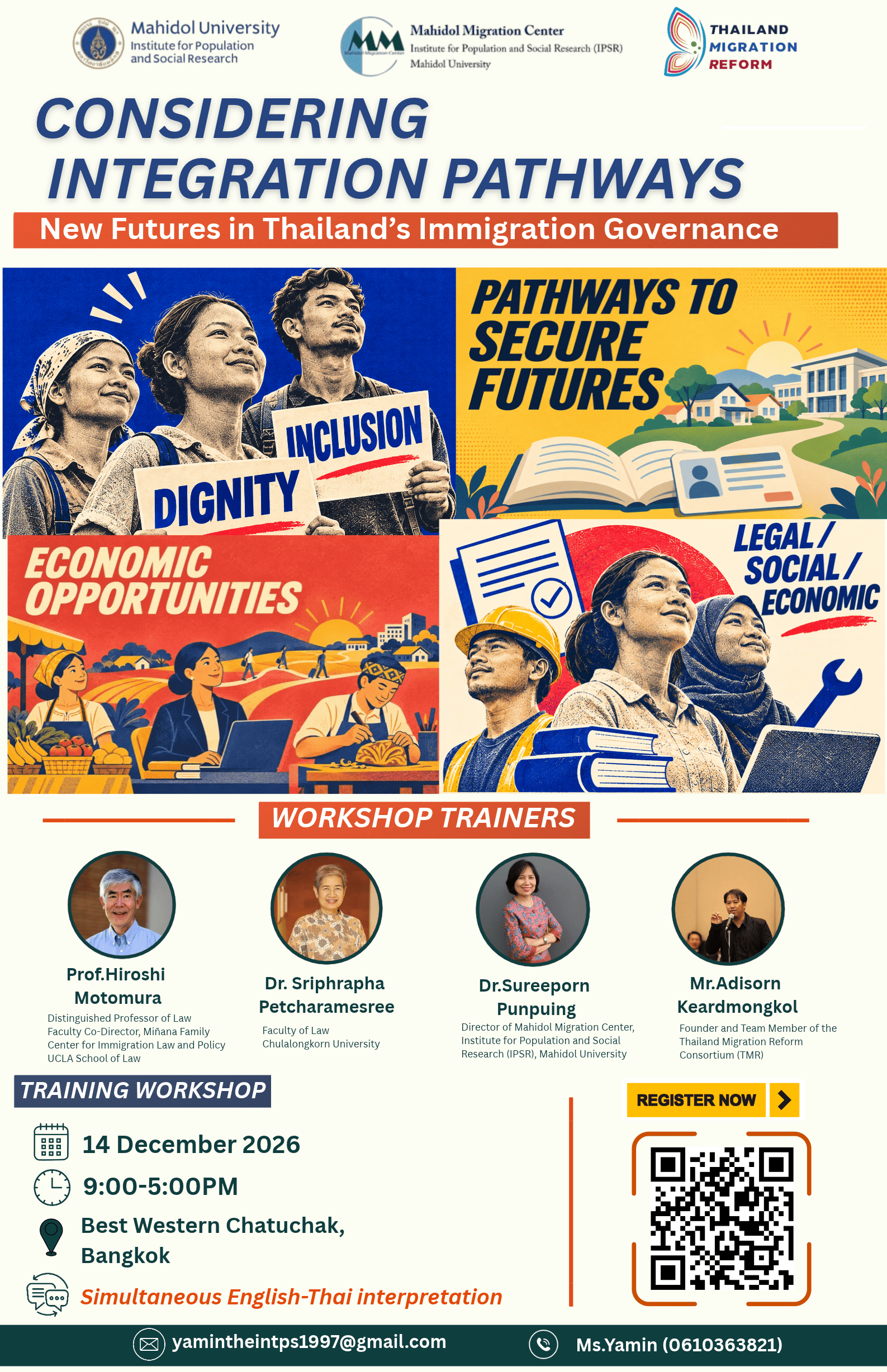
Considering Integration Pathways: New Futures in Thailand’s Immigration Governance
Date: 14 December 2026 ( 9:00 - 5:00 PM )
Location: Best Western Chatuchak, Bangkok
Application Deadline: Monday, 30 November 2026 (5:00 PM, Bangkok Time)
Introduction
As refugee-receiving countries have increasingly restricted access to asylum and resettlement and transit countries in ASEAN struggle with integration, there is a need to understand the political circumstances and legal and practical mechanisms available to people fleeing religious or political persecution and life-threatening conflict. On the other hand, both undocumented migrant workers and urban refugees still struggle for entry into legalization and recognition while residing in Thailand. Given the economic and social protection necessities, the region is due for a consideration of comprehensive integration reform.
Currently, the international refugee protection system is under growing financial pressure. According to UNHCR, by the end of 2025, there were 41.6 million refugees, 9 million asylum seekers, and 68.7 million people displaced due to conflict or violence within their own country (IDPs). UNHCR also reported that available funding covered only 37% of total needs, down from 48% in 2024. These pressures have raised important questions about what legal and practical mechanisms remain available for the right to work. These questions are particularly relevant for Thailand. Thailand introduced its National Screening Mechanism (NSM) in September 2023 to identify individuals who may qualify for “Protected Person” status. However, protection gaps remain for urban refugees, asylum seekers, and undocumented migrants, particularly in access to secure legal status, documentation, and essential services. These gaps highlight the need for a more coherent approach to immigration governance in Thailand.
These protection gaps also raise concerns about the implementation of international standards. While non-refoulement is the acceptable international standard, significant gaps remain between international standards and practices in the region, where refugees and asylum seekers continue to face risks of detention, deportation, and return to places where their lives or safety may be at risk.At the same time, the United Nations agencies have lost much of their funding and political leverage; the implementation of existing international standards for the 1951 Refugee Convention and its 1967 Protocol needs to be rethought considering these changing circumstances.
Integration is considered as a gradual process involving interconnected legal, social, and economic dimensions: secure legal status, access to essential services, participation in community life, and decent work.
In this regard, this workshop is part seminar and part workshop for legal and NGO practitioners, graduate students in ASEAN, allied government practitioners, to reflect experiences and explore better practices from the US, Europe, and other countries including Canada, Norway and South Korea in roundtable settings. Participants will be asked to prepare perspectives from legal and protection pathways, support mechanisms needed for legal integration, social programs for pathways toward job skilling/up-skilling, language capacity training, resettlement plans that integrate community needs, and occupational pathways relevant to Thailand for migrant workers(without legal status), urban refugees, and camp asylum seekers. The workshop will also discuss relevant lessons for strengthening protection mechanisms and possible comprehensive immigrant/migrant integration reform in Thailand.
Goals & Objectives
In this situation, it is an opportunity to create a space for practitioners, academics, graduate students, allied government, and activists to strengthen their understanding of refugee and asylum seeker protection and consider how international experiences can inform better practices and policy development in Thailand.
The workshop will not only provide a venue for critical exchange between humanitarian legal theory and practice, but also some foundational training for recent graduate students and junior practitioners.
Target Participants
The workshop will bring together approximately 20–30 participants, including Thai NGO and civil society practitioners, legal practitioners, activists and researcher-activists, Master's and PhD students, academics, and others working on refugee, asylum, migration, and human rights issues.
The workshop will be conducted primarily in English, with simultaneous English-Thai interpretation provided throughout the workshop.
How to Apply
Interested applicants are invited to submit their applications by Monday, 30 November 2026 (5:00 PM, Bangkok Time).
Late submissions will not be considered.
Application Form Link : https://forms.gle/6MWv8LCE11maH8GG8
Application Deadline: Monday, 30 November 2026 (5:00 PM, Bangkok Time)
Contact Person
Ms.Yamin
Mobile: +6610363821
Email: yamintheintps1997@gmail.com
