
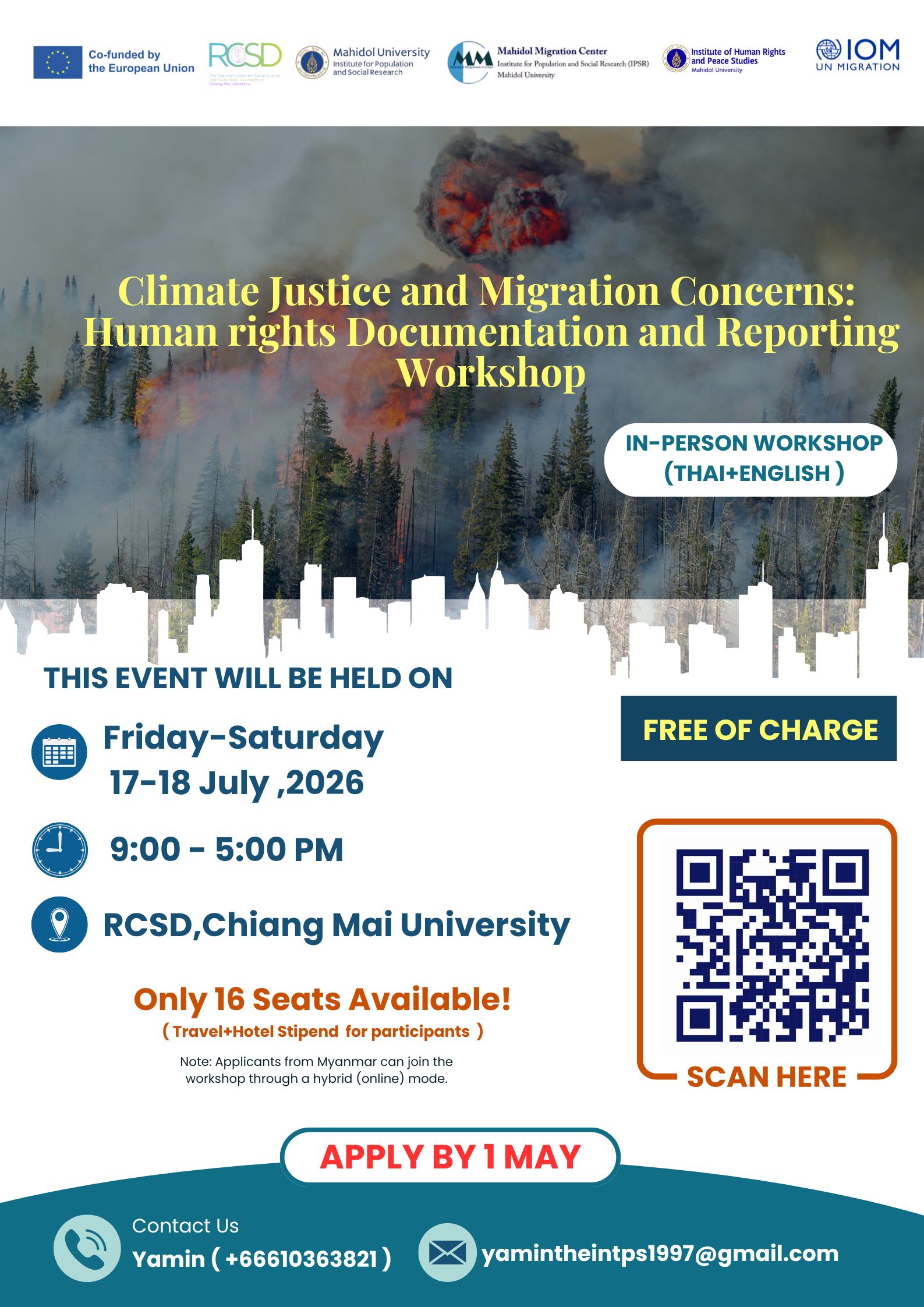
Mahidol Migration Center, Institute for Population and Social Research (IPSR), Mahidol University, in collaboration with Institute of Human Rights and Peace Studies(IHRP) Mahidol University ,the Regional Center for Social Science and Sustainable Development (RCSD),Faculty of Social Science, Chiang Mai University and IOM ( Thailand) invite applications for a two-day interactive workshop on climate justice, migration, and human rights, to be held on 17–18 July at Chiang Mai University.
Workshop Dates: Friday & Saturday ( 17-18 July 2026 )
Application Deadline: Friday, 1 May 2026 (5:00 PM, Bangkok Time)
Background and Rationale
Climate change and environmental pressures are increasingly driving complex human mobility in many parts of the Global South, where rapid development and population growth already strains resources and local and regional ecosystems. Scientists predict ongoing global climate change to trigger adverse events affecting about 143 million people in the Global South by 2050, leading to various forms of human mobility, including migration and displacement. Many global South countries heavily rely on agriculture and natural resources. Rising temperatures, floods, and water scarcity are placing strain on livelihoods and driving rural-to-urban migration. Migration is also deeply shaped by armed conflict and rising food insecurity. In 2021, the military coup in Myanmar led to multi-dimensional crises. The May 2025 Cambodia–Thailand border conflict resulted in mass displacement of over 300,000 people on both sides of the border. The Internal Displacement Monitoring Centre (IDMC) reported that 1.5 million internal displacements caused by disasters have been recorded in 2024 in East Asia & Pacific Regions. The Southeast Asian countries with the incidence of displacements in 2024 due to natural disasters such as recurrent floods, cyclones, and droughts were the Philippines (1,036,000), Myanmar (126,000) and Indonesia (39,000).
Thailand is facing increasing climate-related threats, such as rising temperatures, water scarcity, coastal erosion, and extreme weather events. These challenges are exacerbated by regional conflicts: tensions and conflicts in Myanmar and Cambodia, and legal / political conflicts with Laos, which complicate environmental protection and contribute to displacement from hydro-electric projects. These concerns directly affect livelihoods, agricultural production, and push vulnerable populations, especially migrant workers and ethnic communities, to move in search of safety and income. Yet these movements remain underreported to international monitoring systems, national government, and international agencies. Activists and community practitioners play a critical role in documentation, but many require capacity building, access to tools grounded in rights reporting, ethical data collection, and safe-guarding practices.The threats facing the environment through climate change and pollution are significant and responses are urgently needed. Skills and practices from these disciplines of the environment and human rights are often separated, which weakens their impact. By grounding environmental protection in international law and protection mechanisms and ensuring human rights are applied to situation of environmental degradation, will increase the ability of people to respond to climate change and other environmental stresses.
Objectives
This workshop aims to strengthen the capacity of environmental activists and practitioners working in Thailand to understand and report climate-induced migration from a human rights perspective. As well as develop human rights activists whose work is relevant to environmental rights. The workshop will provide conceptual knowledge and practical skills to document cases, analyze patterns, and improve analysis of environmental data to effectively build advocacy. The workshop is based on the principle of climate justice which frames environmental advocacy in rights context and helps to more accurately target audiences.
One focus is an understanding of the human rights context to environmental and climate-induced migration, and building practical skills in reporting on this, whether this is through a human rights system (such as through the UN), or alternative forms of advocacy such as policy interventions of public outreach. A secondary, but very important component is giving space for the collaboration among activists working at the intersection of environmental justice, climate change, and migration.
Who should apply for this workshop
The workshop is targeted to those people who work in either human rights or the environment and wish to develop skills and knowledge which brings these two areas together. It also will assist advocates who want to expand their skills in the area of developing advocacy materials, and better target their advocacy to the international system, in particular human rights mechanisms.
The workshop includes three main components:
1. A two-Day Interactive Workshop combining presentations, group discussions, case studies, and practical exercises
2. Co-Production of Articles or Brief Reports: Selected participants will collaborate with facilitators to produce 2–3 human rights-based articles or short reports on climate-induced migration in Thailand.
3. Open-Source Curriculum Production: An open-access curriculum will be developed, including key concepts, practical tools, case studies, and reporting guidelines for use by activists, practitioners, activist-scholars, and grassroot communities
Note: Applicants from Myanmar can join the workshop through a hybrid (online) mode.
How to Apply
Interested applicants are invited to submit their applications by Friday, 1 May 2026 (5:00 PM, Bangkok Time).
Late submissions will not be considered.
Application Form Link : https://forms.gle/t3fjgU4mmvXnXV399
Application Deadline: Friday,1 May 2026 (5:00 PM, Bangkok Time)
Contact Person
Yamin
Mobile: +6610363821
Email: yamintheintps1997@gmail.com
